The Problem
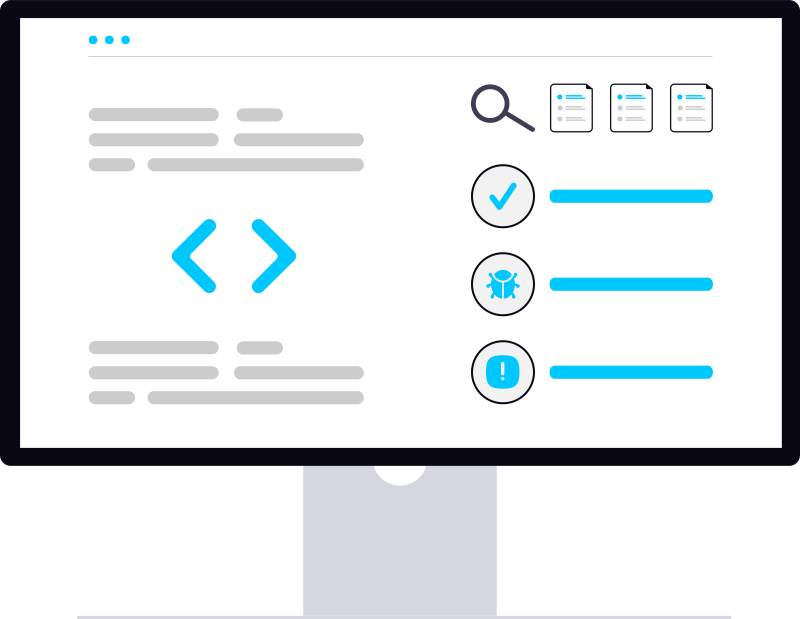
Vulnerabilities are cheapest to fix before they ship
Everything found in production — leaked secrets, vulnerable dependencies, misconfigured IaC — started as a preventable mistake in a pull request.
Secrets leak into repos daily
API keys, tokens and credentials get committed constantly. Once pushed, they're compromised — even after deletion, they live in git history.
Your code is mostly other people's code
Open-source dependencies form 80%+ of modern applications — each transitive package a potential vector, most never reviewed by anyone.
IaC replicates mistakes at scale
One insecure Terraform module gets copied into fifty deployments. Infrastructure-as-code means misconfiguration-as-code without scanning.
Security findings arrive too late
Findings that surface weeks after merge, in a separate tool, assigned to nobody — that's how backlogs are born and never fixed.
Suronex CodeShield
Security that lives where developers work
Every scan type, wired into PRs and pipelines — with AI-generated fixes attached to findings.
SAST
Fast, accurate static analysis on every commit and PR — tuned for low noise so developers keep trusting it.
Code VulnerabilitiesTaint AnalysisPR CommentsOWASP Top 10Secret Detection
Catch keys, tokens and credentials before they're pushed — and find the ones already buried in git history.
Pre-CommitGit HistoryValidity ChecksAuto-RevocationDependency Scanning (SCA)
Know every open-source package, its vulnerabilities, its licence and whether the vulnerable code is actually reachable.
CVE DetectionReachabilityLicence ComplianceSBOMIaC Scanning
Scan Terraform, CloudFormation, Helm and Kubernetes manifests before misconfigurations become infrastructure.
TerraformCloudFormationHelmK8s ManifestsContainer Scanning
Scan images at build time and in registries — base image risk, CVEs and embedded secrets, before deployment.
Base ImagesRegistriesBuild GatesAI-Powered Fixes
Findings arrive with suggested patches and context — merge the fix, not just the ticket. AI-generated code gets scanned too.
Auto-Fix PRsAI Code ReviewGuardrails
Runtime Security
Code-to-runtime correlation
CodeShield connects every running workload back to the exact repository, image and pull request that produced it — and detects drift between what was scanned at build time and what is actually running, so a runtime incident traces to a fixable line of code in seconds.
- Build-to-Runtime Tracing
- Image Drift Detection
- Incident-to-PR Mapping
- Runtime SBOM
Coverage & Integrations
What CodeShield scans
From first commit to running container.
- Source & CI/CD
 GitHub
 GitLab
 Bitbucket
 Azure DevOps
 Jenkins
 CircleCI
- GitHub Actions
- Languages
- Python
- JavaScript / TypeScript
- Java
- Go
- C#
- Ruby
- PHP
- Rust
- Kotlin
- Infrastructure as Code
 Terraform
 CloudFormation
 Helm
Helm Kubernetes Manifests
 Docker
- Pulumi
- ARM / Bicep
- Artifacts
- Container Images
- Registries
- SBOM
- Packages
FAQ
Frequently asked questions
Will CodeShield slow down our pipelines?
No. Scans run incrementally and in parallel — typical PR feedback lands in under a minute. You choose which findings block a merge and which just comment.
How does it reduce false positives?
Findings are validated with reachability analysis (is the vulnerable code actually called?), secret validity checks (does the key still work?) and deployment context from the rest of Suronex — so developers see real issues, not noise.
Does it handle AI-generated code?
Yes. Code written by AI assistants goes through the same SAST, secret and dependency analysis — an increasingly important control as AI-authored code volume grows.
Can findings connect to runtime risk?
Yes — this is where the platform shines. A vulnerable dependency in a repo maps to the running workloads built from it, so you can trace a production attack path back to the exact PR that fixes it.
Which workflows does it integrate with?
PR checks and comments in your git platform, pipeline gates in CI, tickets in your tracker, and alerts in Slack or Teams — with ownership auto-assigned by repo and team.
Keep Exploring